

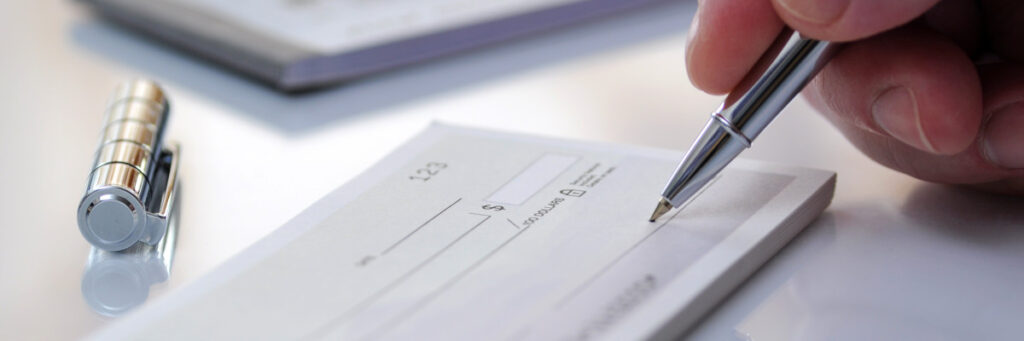
Check washing often flies under the radar, disguised as a payment that was mailed but never deposited. It’s easy to assume the delay is on the recipient’s end, until the repayment notices start arriving or unexplained withdrawals appear on your account.
The aftermath of this scam can include stolen funds and a damaged credit history. While checks are used less frequently today, sending one through the mail can still expose personal and financial information to the wrong people. Understanding how check washing works, and how to prevent it, can help you protect yourself before problems arise.
What Is Check Washing?
Check washing is a form of financial fraud that uses chemicals to erase the ink on a legitimate check, removing the payee’s name and dollar amount. The scammer then rewrites the check to themselves or an associate for a much higher amount.
This crime is rarely limited to a single transaction. Once criminals obtain your routing and account numbers, the fraud can escalate. They may digitally replicate your checks, create counterfeit versions or attempt to access funds through peer-to-peer platforms like Venmo, CashApp or Zelle. Victims often notice one large withdrawal or several smaller, unfamiliar transactions that quickly drain their account.
While tactics continue to evolve, most schemes involve the same core steps:
- Stealing mail to intercept checks before they reach their destination, including targeting personal mailboxes and outgoing mail.
- Cleaning checks using chemical solutions to remove ink.
- Redirecting funds, first through altered checks, then a series of counterfeit payments.
- Selling personal and banking data to expand profits or enable additional fraud.
How Does Check Washing Occur?
Check washing is far from a rare crime. In fact, U.S. Postal Inspectors recover roughly $1 billion in forged checks and money orders each year.
It’s also a decades-old scam that changes with technology. Sending checks through the mail leaves your personal and financial information vulnerable through:
- Stolen or forged mail keys: Thieves may steal a USPS mailbox key or purchase a counterfeit one to access large volumes of mail.
- Mailbox break-ins: Criminals often target USPS mailboxes after hours or scout neighborhoods for outgoing mail left overnight.
- Money mules: Instead of depositing checks themselves, scammers may use third parties to move funds and avoid detection.
- Digital replication: With a single image, criminals can reproduce checks using basic software and specialty paper.
- Banking apps and P2P platforms: Some scammers skip paper checks altogether and use stolen information to request digital payments or access accounts directly.
What Are the Signs of Check Washing?
Knowing the warning signs can help you catch fraud early. Watch out for:
- An unusually large or unexpected withdrawal
- A payee you don’t recognize
- Unpaid bill notices or a recipient claiming a check never arrived
- Multiple peer-to-peer payment requests or small, unexplained withdrawals
- A posted check showing blotchy paper, smeared ink or a bleached, glossy texture
- Handwriting on the check that looks noticeably different
- Misaligned numbers along the bottom of the check
What Are the Risks of Check Washing?
When your financial information falls into the wrong hands, the consequences can extend well beyond a single transaction:
- Financial loss: Recovering stolen funds often takes months and requires extensive documentation.
- Financial disruption: Fraud may delay rent, mortgage or utility payments, and holds placed on your account can temporarily limit access to funds.
- Credit score damage: Missed payments or fraudulent loans taken out in your name can negatively affect your credit.
- Identity theft: Victims may see an increase in phishing attempts, suspicious calls or accounts opened without their knowledge.
How to Protect Yourself from Check Washing
Take the following precautions when sending or receiving checks:
- Write checks using an indelible black gel pen, which is harder to alter
- Mail checks directly from the post office rather than a public mailbox
- Use online bill pay or digital payment options whenever possible
- If you use a mailbox, drop checks right before the last pickup
- Don’t leave incoming mail in your mailbox for more than a day; request a hold when traveling
- Monitor online banking regularly and follow up on checks that haven’t cleared
- Switch to paperless statements to reduce exposure
- Freeze your credit reports to limit unauthorized access
- Sign up for USPS Informed Delivery or use trackable mail services
- Set daily withdrawal limits on checking accounts
- Enable mobile banking alerts for transactions over a certain amount
- Shred old checks and financial documents
- Consider security checks with wash-resistant ink and chemically reactive paper
- Report suspicious transactions to your bank immediately
What to Do If You’re a Victim of Check Washing
If you suspect fraud, act quickly:
- Contact your bank: Alert NVE Bank, A Division of Ion Bank, to unauthorized checks or transactions and request an account hold if needed.
- File a police report: Provide details such as the altered check, amount, check number and a copy of the original.
- Report at the federal level: File fraud reports with the Federal Trade Commission, U.S. Postal Inspection Service and the Internet Crime Complaint Center.
- Set up fraud alerts: In addition to a credit freeze, request alerts from all three credit bureaus and your bank to stay informed of suspicious activity.
Thinking About Opening a Checking Account?
NVE Bank, A Division of Ion Bank, offers checking options designed for everyday life. Contact our team today to learn how we can help protect your finances.